Invoice vs Receipt: What's the Difference?
People use "invoice" and "receipt" interchangeably, and that's usually harmless in casual conversation. In business records, though, the two documents do opposite jobs at opposite moments. One goes out before money moves, the other after — and handing over the wrong one creates confusion for your client, your bookkeeper, and (worst case) HMRC, the IRS, or the ATO.
An invoice says "please pay me." A receipt says "payment received, thanks."
What an Invoice Does
An invoice is a formal request for payment. You send it after delivering goods or completing work, and it tells the client: here's what I did, here's what it costs, here's when I need the money.
A complete invoice includes your business details, the client's details, a unique invoice number, the issue and due dates, itemised line items with prices, tax calculations, payment terms, and payment instructions. It forms the basis of your accounts receivable and the client's accounts payable.
Invoices are legally required for most B2B transactions and are essential for tax compliance — they're how you document revenue and how your clients document deductible expenses.
Need to create one? Use our invoice generator or browse templates by industry.
What a Receipt Does
A receipt confirms that payment has been made. It's issued by the seller after receiving funds. It does not request anything — it simply documents a completed transaction.
A receipt typically includes the seller's name, the payment date, the amount paid, the payment method (cash, card, transfer), and a brief description of what was purchased. Receipts are simpler than invoices because most of the transactional detail has already been captured on the invoice.
Receipts matter most for expense reimbursement (employers typically require receipts, not invoices), warranty claims, returns, and tax deductions where proof of payment is needed.
Side-by-Side Comparison
| Feature | Invoice | Receipt |
|---|---|---|
| Purpose | Request payment | Confirm payment |
| When issued | Before payment | After payment |
| Payment terms | Yes (Net 30, etc.) | No (already paid) |
| Tax detail | Full breakdown (rate, amount) | May include total tax only |
| Used by buyer for | Accounts payable, expense tracking | Proof of payment, expense reimbursement |
| Used by seller for | Accounts receivable, revenue tracking | Confirming collection |
| Legal requirement | Standard, and often required — especially in VAT/GST contexts; rules vary by jurisdiction | Required for cash transactions in many jurisdictions |
When to Use Each One
Send an invoice when: you've completed work or delivered goods and need to collect payment. You're billing on credit terms. You need to charge and document tax. The client's AP department needs a formal payment request.
Issue a receipt when: you've received payment and the client needs proof. You're making a cash sale (receipts are legally required for cash transactions in many jurisdictions). A customer needs documentation for a warranty, return, or expense report.
For point-of-sale transactions (retail, restaurants, services paid on the spot), the receipt is generated at the time of payment and no separate invoice is needed. For B2B transactions, you typically send an invoice first, then optionally issue a receipt or mark the invoice as "Paid" after receiving payment.
Can a Paid Invoice Work as a Receipt?
In practice, yes — often. Many businesses mark the original invoice as "PAID" with the payment date and method, and that serves as both the payment request record and the payment confirmation.
There are cases where a separate receipt is better or required, though: cash transactions (legally required in many jurisdictions), expense reimbursement (some employers specifically require receipts), consumer sales (customers expect a receipt), and audit trail clarity (separate documents create a cleaner trail than modified ones).
When in doubt, issue both. It takes 30 seconds and prevents arguments later.
A Single Sale, Two Documents
Walking through one transaction makes the timing obvious. A freelance copywriter finishes a website's worth of pages for a client:
- The invoice goes out first. INV-0231, issued 1 June, itemising the page copy at £1,200 plus VAT, with terms of Net 14 and bank details at the bottom. At this point no money has moved — the document is a request, sitting in the copywriter's accounts receivable.
- The client pays on 10 June by bank transfer.
- The receipt closes the loop. REC-0094, issued 10 June, confirming £1,440 received against INV-0231, paid by bank transfer.
Same £1,440, same job — but the invoice anticipates the payment and the receipt records it. If you only ever issue one document for credit work, make it the invoice; the receipt is the optional confirmation. If you only ever issue one for an on-the-spot sale, make it the receipt, because there was nothing to request in advance.
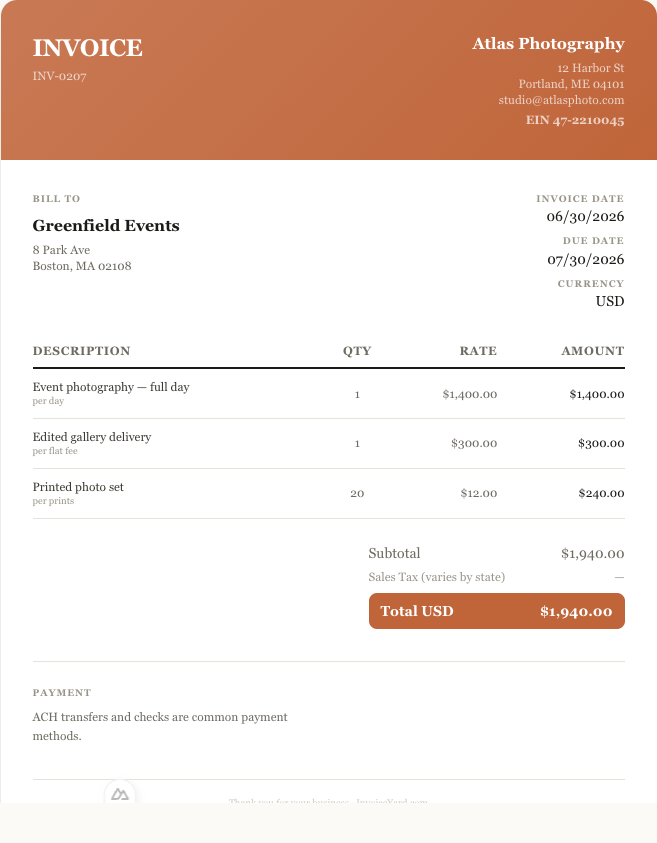 A complete invoice: line items, totals, tax, and payment instructions — everything the client needs to pay and the seller needs to account for.
Record-Keeping Basics
Keep copies of every invoice and receipt you send or receive. Retention periods vary by country: at least 3 years in the US (IRS), longer in some cases, 6 years in Canada (CRA), 6 years in the UK (HMRC), and 5 years in Australia (ATO).
Use sequential numbering for both invoices and receipts, but keep them in separate sequences (INV-001, INV-002 for invoices; REC-001, REC-002 for receipts). This avoids confusion and makes audits straightforward.
Digital records are fine in all major jurisdictions. Store PDFs in a cloud-backed folder structure organised by year and client. Your future self — and your accountant — will thank you.
Two questions that come up often are worth folding in here. First: can an employer require a receipt for expense reimbursement even if you have an invoice? Yes — many expense systems specifically want a receipt because it proves money was spent, not just billed. If you've only sent an invoice, mark it "Paid" with the date and method, or issue a short receipt. Second: do you need to issue receipts if you already send invoices? For most B2B transactions, a paid invoice is sufficient. But receipts are legally required for cash transactions in many jurisdictions, so when cash changes hands, issue the receipt regardless.
Keep reading
Can You Change an Invoice After Sending It? How to Correct Invoice Mistakes
Once an invoice is sent you shouldn't silently edit it. Here's how to void, reissue, or use a credit note to fix wrong amounts, clients, or tax.
8 min readDocument TypesWhat Is a Debit Note? Debit Note vs Credit Note Explained (+ Free Template)
A plain-English guide to debit notes: who issues them, when a buyer or supplier uses one, how they differ from credit notes and invoices, plus a free template.
8 min read